


Scaffodil
The rise and fall of an empire

As humans, we are always tempted to overlook or to control issues and problems, and thus we form what we call the solution-oriented mind. We become "problem-solvers" who seek, find and implement solutions around a problem, while avoiding following the often challenging and unpleasant path to its root, where real healing and transformation are actually possible.
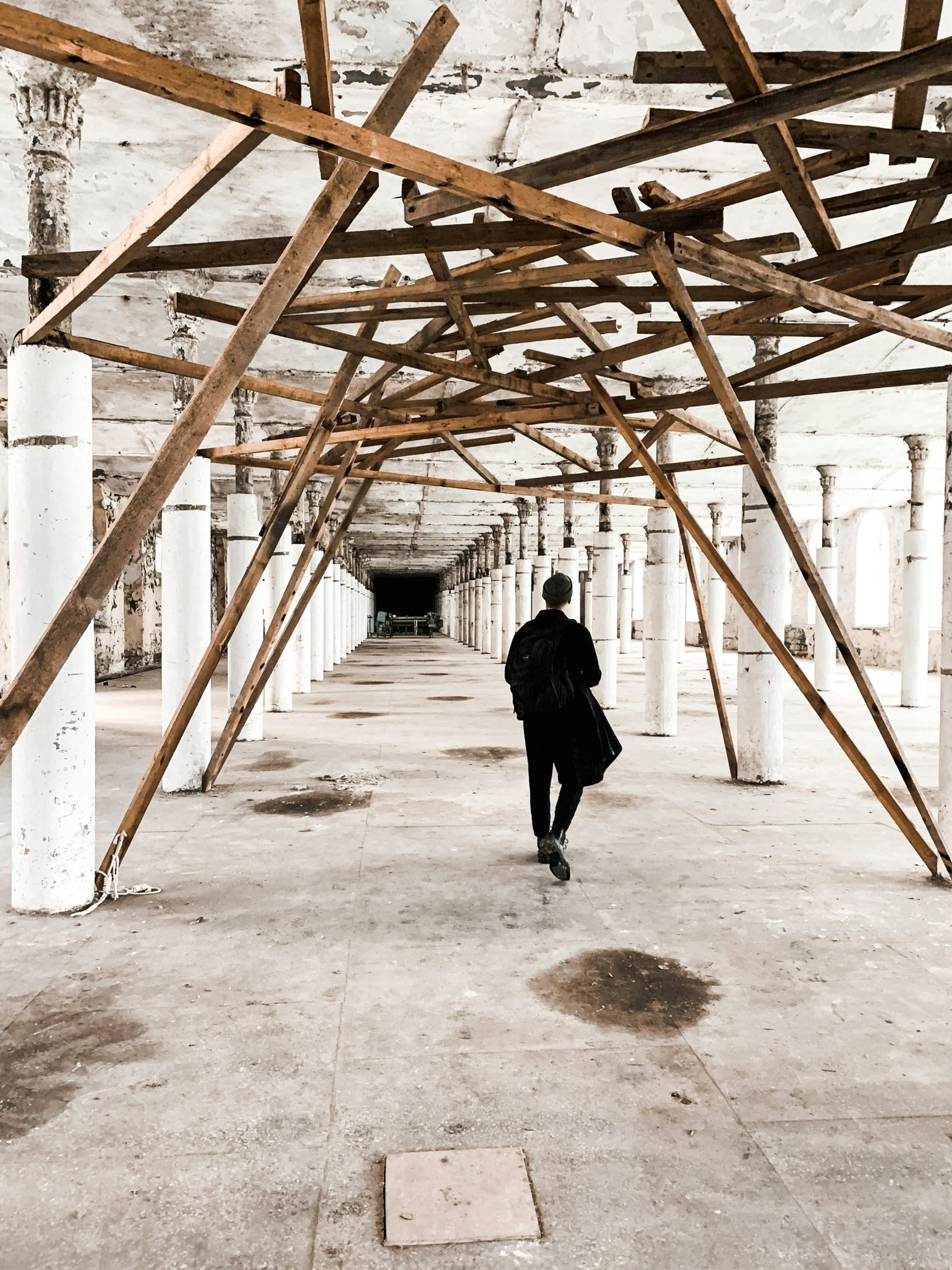
This way of thinking gradually develops a propensity to build on top of what ails us, to create a scaffolding around the languishing daffodil – our titular afflicted flower – and now we have a construct around a natural core that is suffering from a real or perceived disharmony, a disconnection from the cosmic bliss of source and its harmonious manifestation throughout creation.
Of course, we can deny source, connection and harmony, and we can continue to build solutions – structures – that are fulfilled by developing the solution to the problem, but are not really interested in its root or in facing it, because these structures’ existence is dependent on the problem perpetuating their adequacy. This loop creates engagement (or entertainment in the case of overlooking things); it evolves structures, social circles, agendas and organisations, as the number of people engaged in this type of thinking and behaviour increases and follows its course. This whole thing eventually motivates an experience of life and fills it with business.
As this goes on, one day we end up in a gargantuan structure constituted of all the smaller structures within it, and they are all individually and collectively hiding a root problem, a root disharmony, a root disconnection from natural life and well-being. We end up with a languishing daffodil obstructed beneath a scaffold; we are burying nature under a man-made strategy – its gravestone posing as a monument to an industrial complex that produces commercial solutions.
All these structures have an origin. They are structured in their nature, and thus a structure they propagate. Through a structure, they strive to maintain control over the way we approach (or don't approach) the questions and challenges of life. As the structure grows larger, it steadily transforms into an empire – a megastructure overtaken by the intention of solving the problem of life by controlling the way it flows so that problems keep coming, keep being solved, and solutions keep being sold.
We like to talk about sustainability, but to sustainably follow this strategy, the withering of the flower must also be sustained; otherwise life would naturally be blossoming, and everything commercial about the world of solutions will become nonsensical, and the empire will lose its value as a provider of solutions, and eventually its reason to be.
Of course, the withering of flowers, their natural cycle of seed, growth, blooming and returning to the ground, are natural and are maintained by themselves, as that is the nature of natural life, so naturally an effort to "solve" this exists on the premise that natural life has an inherent problem, and controlling, changing and subduing it is the solution.
Through peaceful observation and sincere contemplation, we could come to realise the plainly obvious: that the natural cycles of nature and life are inevitable, and they hold both the promise and the realisation of creation, renewal, diversity, harmony, uniqueness, impermanence and constant transformation, and no structure can substitute for the richness, depth and magnitude of the totality of life.
No empire can control the unfolding of life’s mystery. Life always renews and always refreshes – it always obeys the laws of the universe as it is them – manifested and expressed for us to see, look at, observe and learn from, so that we may too come to abide by them in much the same way that we rest and trust in breathing, eating and sleeping.
Our imperial attempts at controlling the mystery of life, only perpetuate our fear of its immense questions and unfathomable answers, that we try to uncover by building structures on top of our fears of losing this chance at learning about life, of losing this flower to its natural phase of decay before we have understood the mystery of its fragrance…
If we deepen our observation and contemplation, we would see that this strategy we think we have is doomed to fall in one of two ways: disintegrating as the sustained rot enclosed at the base of its root motive (trying to change, control and build on top of the natural course of life) gradually encroaches the structure from the inside out, or collapsing under the unbearable weight of its own structures, crushing the fragility of life's flower.
We need not worry about the world and whether it is an empire or a garden, not before we have looked within us and acknowledged that every human being goes through that challenge: every single one of us is sooner or later stood up at the edge of the abyss (of the unknown) and is invited to take a step in. This choice we can only make within us and for us, and that is enough: do we trust the life that we are and follow it, or do we trust the fear of not knowing it and attempt to rule over it? Do we grow into an emperor or a flower?